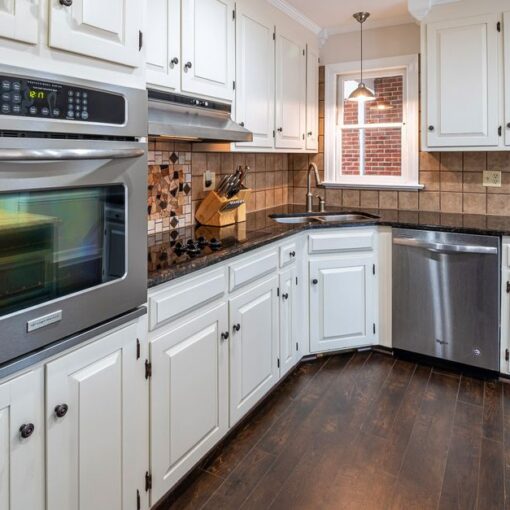
Kitchen cabinet door refinishing is a paint and prep process applied to the doors and drawer fronts you already own. It is not a wipe-down, and it is not a swap for new cabinetry. The work happens in a defined sequence, and the sequence matters more than the color you pick. The clearer you are about which parts of the kitchen the process touches and which parts it leaves exactly as they are, the easier it is to compare quotes and set realistic expectations before anyone opens a can of primer.
The Steps a Cabinet Door Refinishing Job Covers
A refinishing scope follows a fixed order: clean, sand, prime, then coat. Each stage exists to make the next one hold. Skip or rush one and the finish pays for it later, usually in peeling and poor adhesion rather than in an obvious mistake on day one.
Cleaning and Degreasing
Every refinishing job starts with cleaning and degreasing the doors, drawer fronts, and panels. Professionals describe this as the first step of the refinishing process and one that cannot be skipped or rushed. Kitchen doors collect a film of cooking grease, finger oils, and household residue that is invisible once it dries. If that film stays on the surface, paint will not adhere correctly and the coating can peel. Degreasing is unglamorous, it adds time to the schedule, and it is the step most often cut short in a hurry.
Deep Sanding and Grain Filler
After the doors are clean and dry, the surface gets sanded. Shop-based processes treat deep sanding as its own stage, separate from the initial cleaning. On open-grain woods, a grain filler is applied so the pores do not telegraph through the new finish, and the filler itself gets sanded smooth before any coating goes on. Sanding also scuffs the existing surface so the primer has something to bite into. The research does not settle which sanding method or grit sequence is best, so ask your provider to describe their approach rather than assuming every shop works the same way.
Priming and Coating the Doors
Priming is its own step, not a diluted first coat of paint. In a documented refinishing sequence, the day starts by sanding the grain filler, moves on to masking off the kitchen, and finishes with the first primer coat. The coating order on the doors themselves is specific: begin by coating the back sides of the doors, laying them flat so the enamel can level and create a smooth finish. Once those are dry, flip the doors and coat the faces. Laying doors flat is what allows the finish to flatten out instead of sagging or showing brush and roller texture.
Drawer Fronts and Panels
Drawer fronts and panels go through the same cleaning, sanding, priming, and coating sequence as the doors. They are the visible 5 percent of the kitchen you interact with every day, which is why a refinishing scope almost always names them together: doors, drawer fronts, and panels. If a quote lists only doors, ask where the drawer fronts and exposed end panels fall in the plan, because mismatched sheen across those surfaces shows immediately under kitchen lighting.
What Refinishing Does Not Cover
Refinishing changes the finish on existing wood. It does not change the wood itself, the shape of the doors, or the way the kitchen is laid out. That boundary is the single most useful thing to understand before you sign anything.
New Doors, New Drawer Fronts, and Veneer
New doors and drawer fronts in a different style belong to refacing, not refinishing. Refacing suppliers describe their service as giving cabinets a new look by installing new doors and drawer fronts in any style and finish, then securing a quarter-inch thick wood veneer to the cabinet with micro pin nails. That is a materials replacement job. If you want a different door profile, a slab instead of a raised panel, or a wood species you do not currently have, you are shopping for refacing or replacement rather than refinishing.
Cabinet Boxes, Interiors, and Shelving
Refinishing centers on the doors, drawer fronts, and visible panels. The interior of the boxes, the shelves, and the inside of drawers are a separate question that varies by provider and by quote. Some refinishing scopes include the exposed face frames and end panels; others list only the removable fronts. Confirm in writing which surfaces are included, which are excluded, and what the inside of the cabinets will look like when the job is done. This is also where the unknowns in the available research sit: the sources describe door and panel refinishing in detail but do not define a standard scope for cabinet interiors.
Layout, Storage, and Structural Changes
Refinishing does not move a sink, add a pantry, change the depth of a cabinet, or fix a door that no longer closes squarely. It is a finish change, not a construction change. Remodeling services in the market include wood reconditioning tune-ups, cabinet refacing, redooring, and custom cabinetry as separate offerings, which tells you that the industry treats these as distinct scopes rather than variations on one job. The research available here does not define how those providers divide the work, so ask each company for a written scope before comparing numbers.

Refinishing and Refacing Side by Side
The two services are often mentioned in the same breath, and they are not the same purchase. This table reflects what the source material states about each.
| Approach | What changes | What stays |
|---|---|---|
| Refinishing | The finish on existing doors, drawer fronts, and panels through cleaning, sanding, priming, and coating | The doors and drawer fronts themselves, along with the shape and layout of the kitchen |
| Refacing | New doors and drawer fronts in any style and finish, plus a quarter-inch thick wood veneer secured to the cabinet with micro pin nails | The cabinet boxes, which are covered rather than replaced |
Redooring and full replacement appear in the market as separate services as well. The sources in this research do not define their exact scope, so treat any quote for those services as something to verify line by line with the provider.
Shop Work Versus On-Site Work
One practical difference between providers is where the doors actually get refinished. Shop-based processes remove the doors and drawer fronts and complete the cleaning, sanding, and coating stages in a controlled space, where dust, temperature, and airflow can be managed and where doors can be laid flat to level. On-site work keeps everything in the kitchen, which reduces logistics but puts the finish at the mercy of the room.
The research describes the shop as the place where cleaning and degreasing happens first, which suggests the doors travel before they are coated. If a provider tells you the work happens in your kitchen, ask how they control dust and how they plan to lay doors flat for leveling. Those two questions separate a durable finish from one that looks fine until the light hits it.

Prep Quality Decides How the Finish Holds Up
The visible part of a refinishing job is the color. The part that determines whether you are happy in three years is the prep. Cleaning and degreasing cannot be skipped or rushed because the coating will not adhere if the surface is still greasy. Sanding opens the surface and, on open-grain wood, grain filler keeps the pores from showing through. Priming gives the topcoat a consistent base. Each step is a prerequisite for the one after it, which is why a rushed job tends to fail in the same places: around handles, along door edges, and anywhere hands touch daily.
When you review a quote, look for the prep steps listed by name. A proposal that mentions cleaning, sanding, filler, priming, and coating is describing a process. A proposal that mentions only paint is describing a color.
Questions the Available Sources Do Not Settle
Some fair questions about cabinet refinishing do not have a documented answer in the research behind this article. Rather than guess, here is what to confirm directly with a provider:
- Whether refinishing is worth it in your specific kitchen compared with refacing or replacement
- The exact difference a given company draws between refinishing and resurfacing
- Their step-by-step method for refinishing cabinet doors, including coating order and dry times
- Their preferred sanding approach and grit sequence for your wood species
- Which surfaces are excluded from the quote and what they cost to add
Get those answers in writing. A provider who can explain the process step by step is a provider who has done it enough times to know where jobs go wrong.

Working With PaintingCabinet.com
PaintingCabinet.com is a cabinet painting and refinishing specialist serving Highlands Ranch, Castle Rock, Parker, Castle Pines, and Roxborough, Colorado. The company performs factory-finish cabinet painting, refinishing, and color changes with no replacing and no demolition. The process is dustless and completed in 5 days, backed by a 3-year warranty, with more than 1000 kitchens completed and over 50 years of trust and experience in these areas. Homeowners in Parker, Highlands Ranch, Castle Rock, Castle Pines, and Roxborough can call 303-573-6666 for a free estimate or request a free quote through the site form, which goes to factoryfinishcabinet@gmail.com.
Frequently Asked Questions
Is cleaning and degreasing really necessary before refinishing?
Yes. Professionals describe cleaning and degreasing as the first step of the refinishing process and one that cannot be skipped or rushed. Kitchen doors carry a thin film of cooking grease and oils that is not visible once dry. If that film stays in place, the paint will not adhere correctly and the finish can peel, which is why prep gets its own stage in the schedule.
Does refinishing include new doors and drawer fronts?
No. Refinishing changes the finish on the doors and drawer fronts you already have through cleaning, sanding, priming, and coating. New doors and drawer fronts in a different style belong to refacing, where new fronts are installed and a quarter-inch thick wood veneer is secured to the cabinet with micro pin nails. If you want a different door profile, ask about refacing instead.
Why are the backs of the doors coated first?
The documented coating sequence starts with the back sides of the doors, laid flat so the enamel can level and produce a smooth finish. Once those are dry, the doors are flipped and the faces are coated. Laying doors flat keeps the finish from sagging or showing texture, and doing the backs first means the visible face is coated last on a stable surface.
What is the difference between refinishing and refacing?
Refinishing reuses your existing doors and drawer fronts and applies a new factory-style finish to them. Refacing gives the kitchen a new look without buying all new cabinetry by installing new doors and drawer fronts in any style and finish, then covering the cabinet face with a quarter-inch thick wood veneer. One changes the finish, the other changes the materials.
What should be listed in a refinishing quote?
Look for the prep steps by name: cleaning and degreasing, sanding, grain filler where needed, priming, and coating of doors, drawer fronts, and panels. Confirm which surfaces are included, whether exposed frames and end panels are covered, and how the interior of the cabinets is handled. A quote that lists only paint is describing a color, not a process.