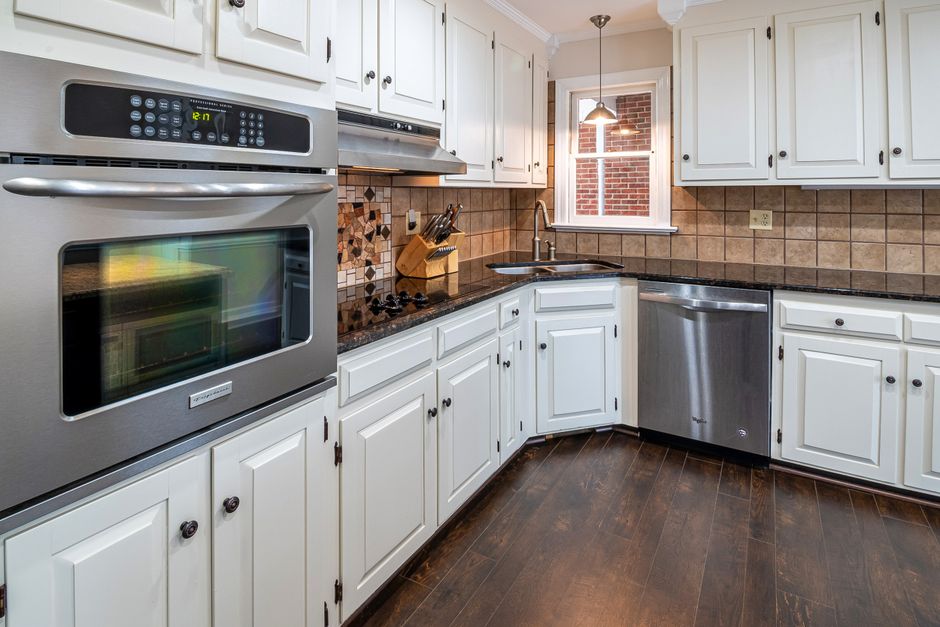
A kitchen cabinet refinishing cost calculator is a budgeting tool, not a bid. It takes a handful of inputs about your kitchen and returns a range that tells you roughly what a professional finish change should cost. Used well, it keeps you from walking into three estimates with no idea what a fair number looks like. Used badly, it turns into a false promise that leads to sticker shock later.
What matters is knowing which inputs actually move the number and which parts of a calculator’s output are just averages. Here is how to run one properly, with an eye on Colorado homeowners in Highlands Ranch, Castle Rock, Parker, Castle Pines, and Roxborough who are comparing refinishing against the alternatives.
What a Kitchen Cabinet Refinishing Cost Calculator Actually Measures
Most calculators on the web are built around one of three jobs: painting and refinishing, refacing, or full replacement. Those are not the same service, and the ranges they produce are not interchangeable. A refinishing calculator estimates the cost of cleaning, repairing, sanding, priming, and spraying your existing doors, drawer fronts, and boxes. A refacing calculator estimates new doors, drawer fronts, hardware, and a veneer over the existing boxes. A replacement calculator estimates new cabinet boxes plus installation.
Type your kitchen dimensions into the wrong tool and you get a confident answer to a question you did not ask. Before you enter anything, confirm which service the calculator is pricing.
- Refinishing keeps the existing cabinet boxes and doors.
- Refacing keeps the boxes but replaces the visible fronts.
- Replacement removes and installs new cabinetry.
The Inputs That Change Your Estimate the Most
Kitchen Size and Cabinet Count
Square footage is the crudest input and the one most calculators ask for first. A 100 square foot kitchen, roughly a 10 by 10 layout, is a common reference size used in remodeling budget tools. But two kitchens of identical square footage can hold very different cabinet loads. A galley with 18 doors and 6 drawers is not the same job as a kitchen with 34 doors and 14 drawers, even when the floor area matches.
Count doors and drawers yourself before you trust a calculator. That count is what drives labor.
Door Style, Drawers, and Panel Profiles
Flat slab fronts and simple shaker doors have fewer surfaces to work around than raised panel or glazed profiles. Paneled doors with deep recesses take more prep, more passes, and more drying time between steps. Deep drawers with routed edges slow a spray operation down too.
If a calculator asks about size but not profile, treat its output as a low-end number for a simple front and a mid-range number for anything with detail.
Finish and Color Choices
A straight color change within the same sheen family is the simplest finish scenario. Going from dark stained oak to a light painted finish means dealing with grain, tannin blocking, and additional coats. Moving lighter usually means more coverage steps. A tool that asks only for a color and not for your existing finish is skipping a real cost driver.
Hardware
Hardware is small, but it adds up fast. A published cabinet painting cost guide from December 2024 lists basic hardware starting as low as $1 to $5 per piece, with high-end designer hardware running $20 to $50 per piece. On a kitchen with 40 pieces of hardware, that spread is the difference between a rounding error and a line item worth negotiating.
Condition and Prep Work
Water damage near the sink, peeling factory finish, grease buildup, and previously waxed surfaces all require extra steps. A refinishing calculator cannot see your cabinets, so it assumes average condition. If your doors are swollen at the bottom or your boxes have water staining, expect the real quote to land above the tool’s range.
Reading the Output Without Getting Misled
Calculators typically return a range rather than a single number, and the bottom of that range assumes everything goes smoothly. Treat the midpoint as a realistic planning figure and the low end as your best case.
- Check whether prep, priming, and topcoats are included, or just the spray day.
- Check whether removal, reinstallation, and rehanging of doors and drawers is included.
- Check whether caulking, filler, and touch ups after reinstallation are covered.
- Check whether new hardware, hinges, and soft-close upgrades are part of the total.
- Check whether the estimate includes a warranty and for how long.
Refinishing vs Refacing vs Replacement: What the Numbers Mean
The gaps between these three services are wide, which is why the calculator you choose matters so much. Refacing, meaning new doors and drawer fronts plus a veneer over the existing boxes, is commonly priced at $100 to $250 per linear foot, or roughly $4,000 to $9,500 for an average kitchen. A separate remodeling budget source puts refacing at $5,000 to $13,000 for a kitchen between 100 and 200 square feet.
| Service | What changes | Published cost reference |
|---|---|---|
| Refinishing | Existing doors, fronts, and boxes refinished | Varies by prep, profile, and finish; confirm with a local quote |
| Refacing | New doors, drawer fronts, hardware, veneer over boxes | $100 to $250 per linear foot; about $4,000 to $9,500 for an average kitchen |
| Refacing (alternate source) | Same scope, priced by kitchen size | $5,000 to $13,000 for a 100 to 200 square foot kitchen |
| Replacement | New cabinet boxes and installation | Priced by linear foot and cabinet grade; use a replacement calculator |
For context on how cost per unit area works in other trades, professional hardwood floor refinishing is often quoted at $3 to $8 per square foot, with a screen and recoat at around $1 per square foot. Cabinet work is priced differently because the labor sits in the fronts, edges, and hardware rather than the floor area.
Why Colorado Kitchens Need a Local Number
A national calculator has no idea what a Colorado crew charges, how far it drives, or how many kitchens it can finish in a week. Local labor rates, travel between job sites, and the number of qualified finishers in the area all shift the final price. A calculator should be your first filter, not your final number.
For homeowners in Highlands Ranch, Castle Rock, Parker, Castle Pines, and Roxborough, the practical move is to run the calculator, write down its range, then get a local quote that accounts for your actual door count and finish condition. PaintingCabinet.com has completed more than 1,000 kitchens in these areas and offers a dustless process with typical completion in 5 days and a 3-year warranty. Call 303-573-6666 for a free estimate or submit the site form for a free quote.
A Simple Workflow for Using the Calculator
- Count your doors and drawers and write the numbers down.
- Note your door style, drawer style, and current finish.
- Decide whether you are pricing refinishing, refacing, or replacement.
- Choose the calculator built for that exact service.
- Run the numbers twice, once with simple fronts and once with detailed fronts.
- Add hardware separately using the $1 to $50 per piece range.
- Compare the result with a written local quote before you commit.
Questions to Ask Before You Accept an Estimate
Every estimate should answer the same set of questions, whether it came from a calculator or a contractor. Ask what is excluded, how long the cabinets will be unusable, how the finish is applied, and what happens if a door is damaged during the process.
- Is the price fixed, or subject to change after inspection?
- How many coats of primer and topcoat are included?
- Are doors and drawers sprayed off site or in place?
- Is the work dustless, and how is overspray contained?
- What does the warranty cover, and for how long?
Frequently Asked Questions
How accurate is a kitchen cabinet refinishing cost calculator?
It is accurate enough to set a budget range and not accurate enough to sign a contract against. Calculators rely on averages for size, condition, and finish, and your kitchen will differ on at least one of those. Use the midpoint as a planning figure, then replace it with a written local quote that reflects your door count and prep needs.
Should I count doors or square footage?
Count everything you can see and touch: doors, drawer fronts, end panels, and exposed cabinet sides. Square footage is a rough filter, but labor in cabinet work tracks the number of individual pieces that need cleaning, sanding, priming, spraying, and rehanging. A door and drawer count gives you the more useful comparison between bids.
Does refinishing cost less than refacing?
Refinishing keeps your existing doors and boxes, so it avoids the cost of new doors, drawer fronts, and veneer. Refacing is commonly priced at $100 to $250 per linear foot, or roughly $4,000 to $9,500 for an average kitchen, because new fronts are part of the scope. Refinishing generally sits below those figures, but only a local quote confirms your number.
How long will my kitchen be out of service?
That depends on the process. A local refinishing specialist who sprays doors off site and reinstalls them can often finish within a week. PaintingCabinet.com uses a dustless process and typically completes a kitchen in 5 days across the Highlands Ranch, Castle Rock, Parker, Castle Pines, and Roxborough areas. Confirm the timeline in writing before work starts.
What if my calculator estimate is far below every quote I get?
That usually means the tool was pricing a simpler service or an average kitchen. If your cabinets have a detailed profile, water damage, heavy grease, or hardware upgrades, the real scope is bigger than the calculator’s assumptions. Compare each quote line by line against the inputs you entered and see which factor the tool ignored.